Tag Archives: loss

SAYING NO

32. SAY NO

  • Especially soon after your child’s death, you may lack the energy as well as the desire to participate in activities you used to find pleasurable.
  • Realize that you can’t keep saying no forever. There will always be that first wedding, christening, birthday party, etc. Don’t miss out on life’s most joyful celebrations. If you attend something and find it overwhelming, it’s OK to excuse yourself and leave early. (HEALING A PARENT’S GRIEVING HEART: 100 PRACTICAL IDEAS AFTER YOUR CHILD DIES; Alan D. Wolfelt, PhD; 2005)

Ugh. It’ll be 12 years this year and I still say no sometimes. I find large social gatherings difficult, anxiety provoking even. I just don’t have the same capacity to socialize as I used to.

Funerals were especially difficult for a very long time. I realize now that was likely because I was in denial about my son’s death. I mean, funerals are no fun any time, but I was always able to support folks. I can do that again now.

When my niece got married, shortly after his death, she acknowledged Joseph in her ceremony. I just now sent her a text thanking her for that.

I missed the weddings of my cousin’s kids. One because I was staying with a friend who was dying. The other, my godchild, because it was on Joseph’s birthday. His birthday and death day are two days I still can’t allow for any kind of celebration…except about him. Maybe not quite celebration…but definitely remembrance.

(featured image found in Google search…attributed to english.eagetutor.com)

SAINT CECILIA PRAY FOR US

27. KNOW THAT YOU ARE LOVED

  • Love gives our lives meaning. To heal, you must learn to love fully again.
  • Think about the people who care about you and the ways in which your life matters.

CARPE DIEM:

Spend some time today with someone who loves you. Focus on this person and what she is saying. Tell her how much you love her too.

It is difficult for me to believe that I am loved. It’s Lent and I have been working with the Hallow app to meditate and try to grow closer, again, to God. I am doing the Pray40: The Return Challenge. We are reading The Brothers Karamazov by Dostoevsky and focusing on its similarity to the parable of the Prodigal son, with some reference to Henri Nouwen’s The Return of the Prodigal Son, which I am also reading a little at a time. God’s Love.

On the Hallow App today, there was an interview with Patricia Heaton, the actress from Everybody Loves Raymond and Malcolm in the Middle. She is, apparently, a devout Catholic. She went on a mission trip as a young adult; and, when she came back, prayed for discernment about becoming a missionary. She asked God to put an end to her auditions if that was what she was meant to do. She then ended up with long-time roles AND has raised money for missions around the world.

So…I spent some time in meditation this morning. My question was, “What do you want from me? I’m sorry to put it this way, but, what do you want from me?” No immediate answer. Heaton and the interviewer prayed in a chapel at a convent for St. Cecilia, where her sister is a nun. I don’t know much about St. Cecilia, except for the fact that she was musical. I prayed along, but got turned off at the mention of her as “virgin”. What is it with Catholics and the preoccupation with virgins? The interviewer mentioned her “husband”…so, she remained a virgin while married??? I have to look into this.

So…I remembered that St. Cecilia was one of my mother’s favorites. Then I remembered her confirmation name was Cecilia. Joseph’s godmother’s name was also Cecelia, spelled differently.

Anyway, this evening I am having dinner with my Survivors of Suicide friend group. We all love each other in a very special way. That’ll be good.

https://www.axiawomen.org/wow/st-cecilia-featured-saint

I HAVE NO ILLUSIONS THAT HE WAS PERFECT

26. TREASURE YOUR CONCEPT OF WHO YOUR CHILD WAS

  • Your child was smart, funny, handsome, sweet. Despite his flaws, you loved him unconditionally.
  • Allow yourself to cling to those things you loved best about your child. Over time, you may find that discussing all aspects of his character and personality–good and bad–with others who knew him will help you work through conflicting thoughts and feelings.

CARPE DIEM:

Gather special photos of the child who died and place them in a small photo album–one you can keep in your purse or in your desk drawer. Try to select photos that capture well your child’s personality, character and passions.

Yes, Joseph was smart, funny, handsome and sweet. He got away with more than his siblings did. He was the youngest, and I’d already been through plenty of nonsense with all of them, including him. I was tired. He was also 22, and there were no more younger siblings after him. So…he got away with a lot. He was the only child who got away with having a sexual partner in his room. The others weren’t even allowed to have a partner IN their rooms. I have this recollection of his saying he was an asshole for doing that. I’m not sure if someone told me that, one of his siblings called him that, or he said it to me in one of my “day(s) in the spirit” (a program I bought through James Van Praagh, a medium) with him.

I have no illusions of his being perfect. He struggled from the time he was very young, emotionally. He had difficulty with social anxiety, and, of course, depression. I recall sitting in church one day during a meeting for his First Holy Communion. The Director of Religious Education, a friend and neighbor, was choosing kids to participate in the May Crowning of the statue of Mary. Joseph’s name was drawn to carry the pillow with the crown. He SCREAMED uncontrollably, and I took him outside. Apparently, the idea of carrying the crown terrified him. So…he didn’t do it.

Another time, he was a shepherd in the Christmas Eve Nativity at Mass. He made it partway around the church, and, when he saw me, stepped out of the procession and sat down with me.

I am having trouble thinking of any real misbehavior on his part…except for having sex with his girlfriend under my roof, which had never been allowed for any of his other siblings. Of course, we had never discussed it; and, I hadn’t disallowed it by any spoken rule. His siblings would never even have considered it.

I recently ordered a bunch of photo prints of him that I had saved in Google Photos, so I will be making that album. 

REMEMBERING

24. TELL THE STORY, OVER AND OVER AGAIN IF YOU FEEL THE NEED

  • The “story” relates the circumstances surrounding the death of the child, reviewing the relationship you had with the child, describing the aspects of the personality of the child who died, and sharing memories, good and bad. (HEALING A PARENT’S GRIEVING HEART: 100 PRACTICAL IDEAS AFTER YOUR CHILD DIES; Alan D. Wolfelt, PhD; 2005)

Funny, just today I was remembering a night Joseph, his sister, and I had gone out to dinner at a place called Steak and Ale. It may have been Christmas Eve. We had been served our dinners and the waiter was serving our drinks. Maybe he was new at his job, because he took a glass from the inside of the tray and as he lay it down on the table, the tray tipped forward, a soda glass fell, and the liquid poured right into Joseph’s dish. His sister and I held our breath. Joseph very calmly said, “I was eating that.” His steak had been perfectly prepared. The waiter apologized, removed the dish and brought him another. I don’t remember if it was cooked as well as the first. My daughter and I have talked about this incident. She recalls holding her breath in anticipation of his reaction.

Joseph could be intense. At that age, though, I don’t think he had the strong reactions he did when he was younger. I used to describe him, as a young child, as wearing his nerves on the outside of his body. When he was happy, he would jump up and down flapping his arms. When he was upset, he would wail uncontrollably.

I remember taking him for blood work. We had to hold him down in the chair, while he screamed, “Why are you trying to rip my arm off?!”

Once, while in line at a cash register in J C Penney, maybe I grabbed his arm a little too tightly, or he thought so anyway. He yelled, “Why do you hurt me every day?!”

Another time, we were at the pediatrician’s office. After checking out at the front desk, I turned around and Joseph was gone! I panicked, looking around frantically. I found him outside, kneeling on all fours in the snow by our minivan, leaning down, eating the snow. He was fine. He must have walked out the door as someone else came in or left. Nobody noticed???!!!

My older daughter once told me that a teacher, who Joseph later had for second grade, loved to watch him waddle down the hallway like a penguin, and hoped he would one day be in her class. (My daughter, eleven years his senior, was friends with this teacher’s daughters.) She really got him, this teacher. He would quickly finish his work; and, she would get him to help others who were having difficulty with the classroom’s computers. One night we attended a science fair at the school. The teacher was manning a table with tangrams. She saw us coming and said, “Joseph can do this!” with a smile. When I ran into one of her daughters at a town event in a park recently, I told her to tell her mom how much I appreciated how she was with him. (I have probably done this multiple times over the years. I still think of her fondly.)

SAYING HIS NAME

23. USE THE NAME OF YOUR CHILD

  • When you’re talking about the death or about your life in general, don’t avoid using the name of the child who has died. Sometimes others are afraid to use the name in your presence out of fear that it is painful to you. If you use the name, others will know that they can use it too. 

CARPE DIEM: Flip through a baby name book at a local bookstore or library and look up the name of your child. Reflect on the name’s meaning as it relates to the unique person you loved. (HEALING A PARENT’S GRIEVING HEART: 100 PRACTICAL IDEAS AFTER YOUR CHILD DIES; Alan D. Wolfelt PhD; 2005)

I would like to begin here by saying that I still love Joseph, in response to the “unique person you loved” prompt above. My love for him is ever present. It did not die with him.

I don’t hesitate to use his name; and, I am ever grateful to hear others say it. It is a pleasure to know that they, too, remember him.

I don’t need to go to a bookstore to look up the meaning of his name. I can, “Ask the Google,” as we say in my family:

The name Joseph has its origins in Hebrew and holds significant meaning. Derived from the Hebrew name Yosef, it translates to God will Increase. This name has deep roots in biblical history, prominent in the narrative of the Old Testament. Joseph, son of Jacob and Rachel, was a central figure whose life and virtues are vividly recounted in the Book of Genesis. (accessed at https://www.ancestry.com/first-name-meaning/Joeseph)

The only surprise is that the name translates from the Hebrew to “God will increase”. God certainly did increase. Joseph was the fourth of our children. When I was pregnant with him, I woke from a dream one day and said, “How about Joseph Francis?” I had previously been considering James Andrew, the name of my great grandfather from Scotland. His father didn’t like the idea, having an uncle “Jimmy” of whom he wasn’t particularly fond.

I was thinking of Joseph, for the dreamer of the Old Testament, mentioned above as the son of Jacob and Rachel, and also for the earthly father of Jesus. I always called him Joseph, not Joe or Joey. When he was little, his father called him Josie, which was picked up by some in the family for a while. Josie reminded me of the Clint Eastwood character, The Outlaw Josie Wales, although his dad pronounced it with a softer “s” sound. My grandkids called him Uncle Joe. His friends called him Joe. He called himself Joe on his FaceBook page. One of his sisters called him Broseph. She still does when she posts about him.

FAMILY IS COMPLICATED

22. COMMUNICATE OPENLY WITH YOUR FAMILY

  • Your partner and your surviving children are hurting, too–each in their own unique ways. Nobody can (or should try to) take away the hurt, but talking about all your thoughts and feelings since the death helps everybody feel supported and understood. 
  • Is yours an “open family system,” in which members openly talk about the death, the person who died and their grief? Or is yours a “closed family system,” in which members pretty much keep their thoughts and feelings to themselves and don’t feel safe mourning among their own family? (HEALING A PARENT’S GRIEVING HEART: 100 PRACTICAL IDEAS AFTER YOUR CHILD DIES; Alan D. Wolfelt, PhD; 2005)

Hmmm…I thought we were an “open family system.” We mentioned Joseph’s name all the time. But we talked about him, mostly, in the present tense. Like he was still alive and with us. We still talk about our experiences of feeling him near, making himself known to us. 

The day after I found him, I went to my youngest daughter’s apartment, after she called me. She already knew about Joseph’s death having gotten the news, I assume, from one of her siblings. She hadn’t returned my call to find out why I’d left her a message the night before. She took my hands, when I entered her apartment, looked me in the eyes and said, “It’s not your fault; and, you’re going to need a lot of therapy.” I felt such relief, hearing her say those words. I was sure everyone in the family would blame me. My ex-husband, my children’s father, even came to the apartment and was supportive of me in his own grief.

Years later, when I told her what her sister had said. “the last time you told someone they were homeless, they killed themselves,” she kind of nodded and shrugged. So maybe she does blame me. We don’t talk about it. We don’t talk about how we feel in our grief. She and I, and her daughter, took a trip out West for Joseph’s 30th birthday. The night of his birthday, we were all tired, having spent the day sightseeing…that was the day we kayaked the Colorado River. I guess we’d all said we were tired and I suggested maybe we not go out. She snapped at me and said my granddaughter still needed to eat. At dinner, there was mostly silence. Several times I tried to bring up Joseph and talk about him. We would be interrupted by the wait staff, or something, and the conversation never got off the ground. She may have been doing things on her phone. I just remember feeling alone, although we were all together. I got the impression she was angry with me and maybe would have preferred I wasn’t there. I was in a lot of pain that night, having been in the kayak alone, she and my granddaughter sharing one. Paddling against the current was difficult. I slept on a sofa bed, while they shared the bedroom. It was terribly uncomfortable. I ended up closing it and sleeping on the sofa instead. I struggled to sleep, and thought about changing my flight to go home the next day. But…morning came. I think we talked a bit, and I stuck it out. It was, all in all, a beautiful trip. We saw the Grand Canyon, Joshua Tree and Zion National Parks. But it was terribly bittersweet.

She volunteers with the American Foundation for Suicide Prevention (AFSP) and shares openly about her experience in posts, as their Social Media Ambassador, so I do see how see manages her grief. But, again, we don’t talk about it. And, I am only now getting to experience my own grief and mourning…almost twelve years later. Our relationship is improving.

I don’t have a partner. My renewed relationship after Joseph’s death survived almost three more years, but we didn’t talk about our grief either. I remember watching the film, “The Passion,” and afterward kneeling down on the living room carpet where Joseph’s body had lain and crying, maybe screaming, identifying with Mary, having lost her Son. My partner left the room. I suppose he didn’t know what to do with me. I don’t think I ever even considered he might be experiencing any grief over Joseph’s loss. He’s married now. 

My relationship with my eldest daughter is improving. We communicate via email, although we live in the same town; however, the emails are more frequent and conversational.

My other son, well, he still isn’t speaking with me. It’s been almost 11 years. So…could it be related to Joseph’s death? I saw him at my mother’s wake and funeral. I said, “Hello, Son;” and he looked like a deer in the headlights. So, I walked away. He stood in for a picture with me, his younger sister, and my granddaughter that his girlfriend took. My eldest daughter didn’t come to either the wake or funeral.

It’s a complicated family. Aren’t most?

I WILL SEE YOU AGAIN

20. MOVE TOWARD YOUR GRIEF, NOT AWAY FROM IT 

  • Our society teaches us that emotional pain is to be avoided, not embraced, yet it is only in moving toward our grief that we can be healed.
  • Of course, it’s also necessary to dose yourself with your grief. Sometimes you will need to distract yourself from the pain. But in general, you should feel that you’re moving toward your grief – toward an understanding and acceptance of it. (HEALING A PARENT’S GRIEVING HEART: 100 PRACTICAL IDEAS AFTER YOUR CHILD DIES; Alan D. Wolfelt, PhD; 2005)

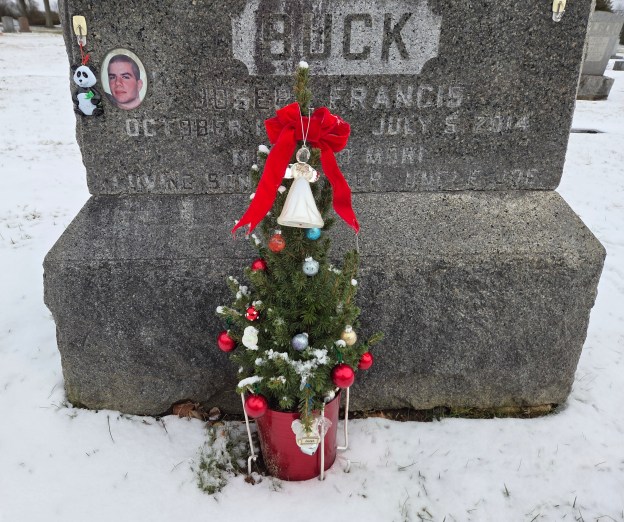
I stopped by the cemetery over the Christmas holidays. Someone had left a little decorated Christmas tree. It was windblown. I straightened it up and smiled. I assume it was left by his dad, or maybe his sister. Someone had also hung a panda ornament from the grave stone. Joseph loved pandas.

I am consciously moving toward my grief, finally. For so long, the trauma of finding him dead, and my guilt as a result, were in the way. I remember that he lived. I am taking time to allow good memories to arise and feel joy in having known him. Yes, he struggled, and I worried about him, but there was so much joy in having had him in my life.

We travelled to Washington, DC, he, his sister and I, to see the baby pandas at the National Zoo when they were kids. I still have the stuffed animals I bought for him there. Recently, my daughter bought supplies for an event at my granddaughter’s high school, and, inexplicably, a toy panda was in the packaging. He finds ways to show us he’s around.

I will be watching something on TV and a memory of him rises up, sometimes, sadly, it’s a scene of someone dying by suicide having used the method he chose. I allow myself the sadness and the tears in remembering. Sitting with them, just with the sadness, not the guilt. Guilt is such a cruel emotion. It can be useful, sure, but sometimes it just wields its blade to cut and hurt. I tell clients, just say, “Hello, Guilt, I see you,” and let it pass. I know how hard that is to do. I will work on giving myself the same grace.

I miss you, Joseph. I wish you would have stayed. Maybe you would have a family now. I would love to see you with your own kids. I think you would have made a wonderful dad. I love you, Son. I will see you again.

EMPTYING

19. FIND WAYS TO UNDERSTAND AND COME TO THE LIMITS OF YOUR GUILT

  • Talk about any lingering feelings of guilt, regret and remorse. Don’t nurse them and continue to punish yourself for them. Instead, give them voice and see how their power over you diminishes.
  • I would be remiss if I did not point out that some parents are in fact partly or wholly responsible for their child’s death, whether it was intentional or accidental. These parents often benefit from professional help in dealing with their overwhelming guilt. (HEALING A PARENT’S GRIEVING HEART: 100 PRACTICAL IDEAS AFTER YOUR CHILD DIES; Alan D. Wolfelt, PhD; 2005)

UGH! What a mixed bag of feelings this brings up. These are only two of the bullet points that appear on the page I read today.

I chuckled when I saw the title. I’d just listened to, and meditated on, the recording for today in the Hallow app’s PRAY40 challenge, a Lenten practice. We were asked to reflect on “What ‘junk’ do you need to remove from your heart this Lent?” My immediate reaction was GUILT! Then I decided to meditate for 20 minutes and see what arose. I saw a black darkness, then the Gollum I mentioned in yesterday’s post. I decided that I need to remove from my heart that image of myself as not good enough, bad, evil – to see myself as God sees me.

So, I was tickled to see “FIND WAYS TO UNDERSTAND AND COME TO THE LIMITS OF YOUR GUILT” at the top of the page. I was reassured by most of the author’s bullet points, especially the first one, noted above, where it says not to nurse feelings of guilt. I thought, great, I can do this, I can unpack the heaviness I carry around with me, cut myself a break.

Then I read the second one noted above…some parents ARE partly or wholly responsible for their child’s death. THAT was like a smack in the face…“You’re not getting out of this THAT easily!!!” 

I didn’t kill Joseph. He killed himself. BUT, he did it after I told him that he could no longer live in my house. I should note here, that he had made several other attempts that were not reactions to anything I said or did. And I know that not everyone will kill themselves because their mom kicks them out of the house.

I participated in an on-line suicide loss group run by David Kessler, another renowned grief loss professional. I got on live with him, one-to-one, and told him my son’s death was my fault and why. He assured me that there were likely other parents who lost a child and blamed themselves for NOT using tough love. So…none of us can help but blame ourselves.

So…IS it partly my fault? I don’t know. I do know that I worked hard at being a parent. I STUDIED to be a parent. I read books, I took courses, I talked to professionals, educators, and friends. I reached out for help wherever I could find it. 

I told him, when he moved back in with me, no alcohol, no drugs. And while I was away, he went out and got his drug of choice and used it. I found the packaging; and, I told him he’d broken our agreement. I told him my heart was broken. 

A part of me believes that he stayed as long as he did for my sake. (Although he had made previous attempts, he either reached out to someone or someone found him in time to save his life.) I think, when I said my heart was broken, it gave him permission to leave.

Another one of my children, not too long ago, after being hospitalized for a psychotic episode, said to me, “The LAST time you told someone they were homeless, they killed themselves. Is that what you want?” I had created a contract for her to return to my home. She didn’t sign it, but I told her that by returning to my home, she had, in fact, agreed to it. I tried to explain to her that I wanted her to be aware of what she needed to do in order to continue living with me, or she would be homeless, and the hospital would have to find her a place to stay. I didn’t get past the word “homeless” before she spat out that comment. She and I had been down this road before and she had lived in a group home for a while. She is back to living on her own and is working again.

So, my guilt over my son’s death is compounded by dealing with ongoing mental illness in my other children…or not dealing with it, because they won’t talk to me. In any case, the worry, and the guilt, remain.

“BE ANGRY BUT DO NOT SIN” (Ephesians 4:26)

18. KNOW THAT IT’S OKAY TO FEEL ANGRY

Grieving parents often feel angry – at others whom they perceive caused or contributed to the death, at themselves for letting it happen, at God, even at the child herself for having abandoned them. (HEALING A PARENT’S GRIEVING HEART: 100 PRACTICAL IDEAS AFTER YOUR CHILD DIES; Alan D. Wolfelt, PhD; 2005)

Anger wasn’t one of my feelings. It is not an emotion I am comfortable with. Well, for myself that is. I have no trouble feeling anger at injustice toward other people, but that’s a whole other topic.

It may have crept up here and there. Before Joseph’s death, I had taken him to an appointment with a psychiatrist at a local clinic. He came out saying the doctor told him his diagnosis was “laziness”. THAT pissed me off. Medical professionals, especially in the field of psychiatry, ought to have a better understanding of the people with whom they interact and for whom they prescribe. A little compassion would be appreciated.

I can’t say I was angry about it, but I wondered why my other kids, and their father, didn’t check in on him that day. I had let them all know that I had found packaging from his drug of choice and that I had given him the weekend to find somewhere else to live. It is all too easy and comfortable to take on blame and guilt myself. I wish they had checked in on him. I don’t know that it would have made a difference.

I wish that he would have made a choice to stay. I have smacked his photo on the grave stone and called him a brat, but I don’t feel angry about it, not for long anyway.

I have a difficult relationship with anger. Somewhere, sometime, somehow, I internalized the idea that it is wrong to feel angry. I have seen the pain inflicted by people who just let their anger fly. Anger scares me. (Unless it’s righteous anger, which I experience for others, of course.) If I experience anger for myself, which is rare: and, I try to speak up and out in defense of myself, which is rarer still, I inevitably end up in tears, which is not at all helpful.

I have this awareness, though, that deep within me exists a rage in chains. I don’t know what it is or where it comes from, but it’s there. I wish I could let it out. It’s that Gollum deep inside, that ugly creature I think is me, that if anyone really got to know me they would see.

At some point, in therapy, I became aware that this Gollum is actually a frightened child who feels not good enough. I try to spend time with her, on occasion, and let her know she is loved. 

It’s not easy being me.

Sometime after Joseph’s death, I participated in a meeting at my county’s mental health and addiction services office, a focus group of sorts. They were asking for community input on gaps in services. I told them that there needed to be more long-term residential support for people experiencing co-occurring, mental health and substance use disorders. Joseph had been in rehabs, hospitals, halfways houses…but it was for treatment of one or the other. He needed support for both. I don’t know if that has gotten any better, but I think not.

I worked as a psychiatric screener for a while. I had a guy come in who needed treatment for both. I held him in the unit, with his consent, trying to find an appropriate placement. One day, while I was sent out on another call, management kicked him out, escorted by police. I was angry then! It was run more like a jail than a medical facility. Not long afterward, I found another job. That’s a whole other disappointing story – Partial Hospitalization, Intensive Outpatient program (PHP/IOP).

So, now I’m retired. I guess. I have a hard time admitting it. I take assignments now and then through a company with which I am considered “On Demand”. I’ve also agreed to work in an outpatient private practice one day a week, but no clients yet. Maybe it’s not meant to be. Meanwhile, for the most part, I’m enjoying not working.

(Featured image accessed at https://news.stthomas.edu/publication-article/the-unbearable-sadness-of-being-gollum/)

BEING HERE NOW

16. BE AWARE THAT YOUR GRIEF AFFECTS YOUR BODY, HEART, SOCIAL SELF AND SPIRIT.

  • Grief is physically demanding. The body responds to the stress of the encounter and the immune system can weaken. You may be more susceptible to illness and physical discomforts. Grieving parents often describe their grief as a pain in the chest or a physical ache. You will probably also feel sluggish or highly fatigued. Some people call this the “lethargy of grief”.
  • The emotional toll of grief is complex and painful. Mourners often feel many different feelings, and those feelings can shift and blur over time. 
  • Bereavement naturally results in social discomfort. Friends and family often withdraw from mourners, leaving us isolated and unsupported. Mourners often feel out of place in a setting they once felt a part of.
  • Mourners often ask, “Why go on living?” “Will my life have meaning now?” “Where is God in this?” Spiritual questions such as these are natural and necessary but also draining. 
  • All four facets of yourself are under attack. You may feel weak and powerless, especially in the early weeks and months. Only over time will you gain the strength to fight back.

CARPE DIEM: 

If you’ve felt physically affected by your grief, see a doctor this week. Sometimes it’s comforting to receive a clean bill of health. (HEALING A PARENT’S GRIEVING HEART: 100 PRACTICAL IDEAS AFTER YOUR CHILD DIES, Alan D. Wolfelt, PhD, 2005)

Usually, I just pick a snippet from the page, but today, all of it grabs my attention. It all rings true for me. It’s a snowy day here in the northeastern US. I’m enjoying being in my nice warm home, with a blanket on my lap, and a cup of tea. My kids would laugh about “my nice warm home”. I keep it at 65 when I’m up and 60 when I’m out or in bed.

Grief certainly is physically demanding. It’s a full-body experience. As my rent heart mends back together, I can finally feel the grief and externalize it into mourning. I could always talk about Joseph’s death, but a part of me still didn’t believe it. I remember at the burial site, standing at the foot of his casket. I didn’t sit with the rest of the mourners. I stood opposite the Deacon, who prayed the final prayers at the head of the casket. We looked into each other’s eyes. “May perpetual light shine upon him…And may his soul and the souls of all the faithful departed, through the mercy of God, rest in peace. Amen.” It was all so unreal.

My friend from Maine had driven me to the funeral home where I met my ex-husband, his wife, and our daughters, to make the “final arrangements”. Just as we were leaving to go there, a Deacon from my church and his wife came to the house. I told Deacon Steve and his wife, Lois, that I had called the rectory the night it happened. His response was, “Where was your community?” If only I had called them directly…The priest I spoke with only told me that the funeral home would call them to make arrangements. 

The funeral director was a lovely man, who had also lost a child. Her portrait hangs in the entryway. I was okay while we sat at the desk in his office…or as okay as I could be. I don’t know that I said anything. When we were led into the showroom to choose a casket, I couldn’t enter the room. I backed out and went outside to be with my friend. I don’t remember if I went back in. It was that sense of unreality. That rending between what was and what I accepted. Again, I say that it is only recently that I believe he is really dead…through the process of working through this book and having been to Dr. Wolfelt’s presentation.

I am always in pain, in most of my body. I have been diagnosed with fibromyalgia, which was basically a rule-out of other diseases. I know, and I teach, that we carry our traumas in our bodies. This is the heaviest of the traumas I have experienced. The burden is made greater by my guilt and all the “what ifs” and “if onlys”. I have participated in various grief groups, in-person and virtually. They have all been helpful in one way or another. The suicide survivor groups have probably been the most helpful and I have made friends through them. No one else understands the depth of this particular loss. We see each other socially as well.

Social situations are very difficult for me. I prefer one-on-one get-togethers. Anxiety and a sense of just not fitting in anymore interferes with going to parties, celebrations, and group events, except for with the survivors, who feel the same way and give comfort to each other as a result of this understanding.

Day to day living can seem pointless at times. Heavy. But I have learned to Be Here Now, again, as Baba Dam Rass would say. There is a sacredness in each moment, each breath.